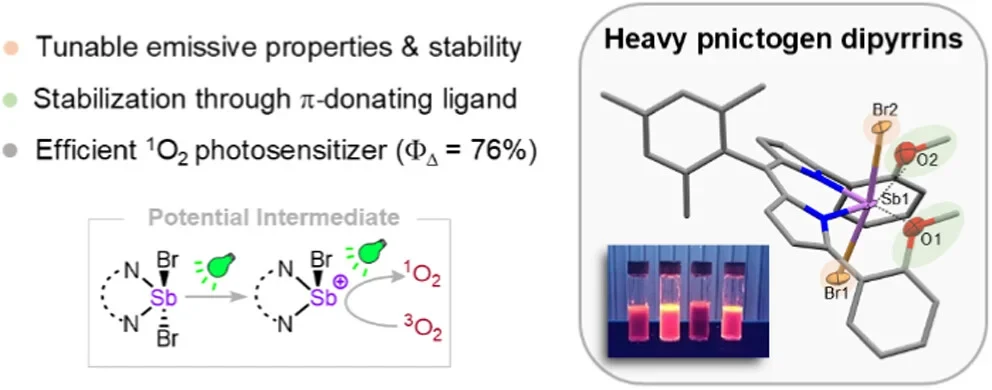
Die Arbeit wurde vom AK-Bismuto geleitet und von den AKs Kornienko und Grimme unterstützt. Sie wurde im Juli 2025 in Inorganic Chemistry veröffentlicht.
Abstract
The unique chemical reactivity offered by photochemistry has driven a growing interest in the design of new photocatalysts with diverse chemical properties. Incorporating heavy atoms into the core of chromophores presents an excellent opportunity to achieve this by enabling a long-lived excited state. Herein we report the design, synthesis, and characterization of new Sb- and Bi-based dipyrrins with a significantly increased stability in solution, improved luminescent properties, as well as their use in photocatalysis. Furthermore, the applicability of a new Sb-dipyrrin photosensitizer ArOMe-Sb-Br is highlighted in the oxidation of different functional groups, performing especially well in the oxidation of alkenes (TON up to 5500). In addition, the singlet oxygen efficiency was found to be ΦΔ= 0.76, a value as high as benchmark photosensitizers such as chlorophyll a and metalloporphyrins. We have performed further investigations using cyclic voltammetry under light irradiation with complementary density functional theory (DFT) calculations to elucidate the redox properties of our new set of heavy pnictogen dipyrrins. Despite the theoretical and experimental challenges, both cyclic voltammetry and DFT corroborate the formation of a cationic complex resulting from light-induced bromide dissociation. Our work paves the way for exciting new possibilities in light-driven applications using main-group elements.