Abstract
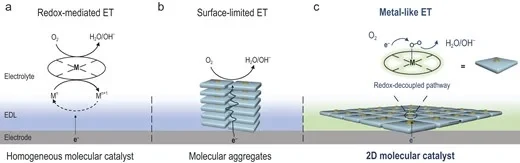
Molecular catalysts facilitate electrochemical conversion by changing their oxidation states to transfer electrons. However, this redox-mediated mechanism features stepwise electron transfer and substrate activation in separate elementary steps, thereby resulting in an inherent loss in efficiency. Here, we synthesize a two-dimensional (2D) iron phthalocyanine (FePc) material and uncover its non-mediated electron transfer behavior in electrocatalysis, which overcomes the conventional redox-mediated limitation in the oxygen reduction reaction (ORR) pathway that molecular catalysts face. The 2D geometry enables the FePc molecules to be positioned within the electrochemical double layer, enabling electrons to directly transfer to oxygen reactants, prior to the Fe(II/III) redox. This functions in a manner akin to a metal catalyst thereby opening a redox-decoupled ORR mechanism. As a result, the reported 2D FePc molecular catalyst exhibits unprecedented ORR half-wave potential at 0.945 V vs. the reversible hydrogen electrode, achieving efficient application in zinc-air batteries and H2/O2 fuel cells. These findings open new possibilities in voltage efficient, redox-decoupled molecular catalysis that integrates strengths of molecules and materials in one synergistic system.